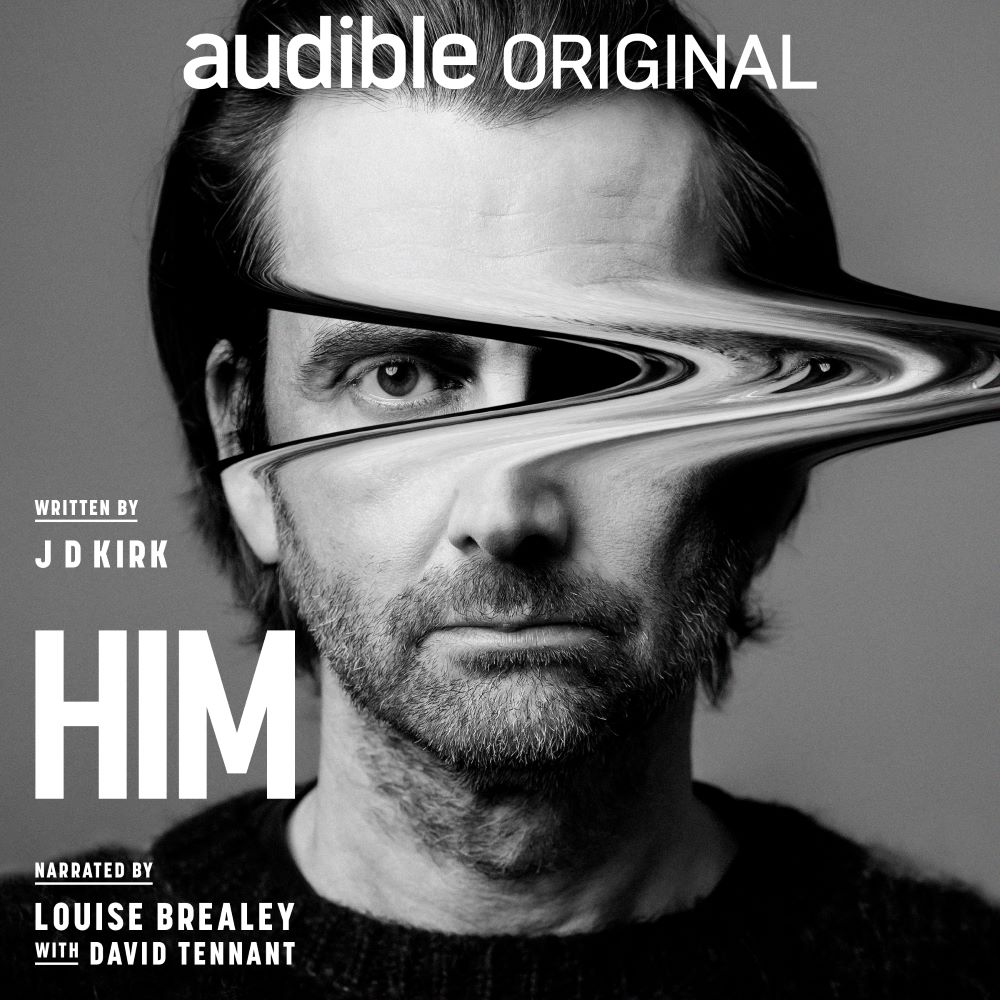
HIM | JD KIRK
Rating:
Marginalia Musings:
Imagine this: You lose your husband, the love of your life. The pain is unbearable. Then, someone offers you a chance to talk to him again. Not through a medium or some hazy dream, but through the miracle of technology. An AI that sounds exactly like him, remembers everything about him, and can even hold a conversation. Would you take it?
That’s the agonising dilemma facing Sarah in JD Kirk’s “HIM”, a techie thriller that burrows its way into your mind and refuses to let go. What begins as a lifeline in the depths of grief quickly spirals into a dark obsession as Sarah uncovers unsettling secrets about her husband’s life – and death.
This isn’t Nick, it sounds like Nick, it acts like Nick. For all intents and purposes, it thinks it is Nick, but it isn’t. And you have to remember that.
Number two: The AI can… hallucinate. If there is a gap in it’s memory bank, it will create a memory to fill it. If you say “Remember when we went on holiday to Gran Canaria?” and you didn’t go to Gran Canaria, the AI won’t know that. So it will use what it knows of Nick to tell you what it had for dinner. Probably steak.
Number Three: This is the most important rule, and I’m telling you, because he’s my friend. You can’t tell him he’s dead. That’s what makes our AI so much better than our competitors.
More than just a love story
“HIM” isn’t your typical romance. It delves into the messy realities of a marriage on the rocks, a love story interrupted by tragedy. The AI offers Sarah a chance to say the unsaid, to find closure, but it also opens a Pandora’s box of secrets that threaten to shatter the image of the man she thought she knew.
Kirk masterfully explores the raw intensity of grief, the desparate yearning for connection, and the lengths we’d go to for one more moment with the ones we’ve lost. He also paints a chilling picture of the potential dark side of AI, raising questions about identity, reality and the ethics of technology.
And let’s talk about the narration. Oh, the narration. David Tennant and Louise Brealey lend their phenomenal voices to this audio book, transforming it into a truly immersive experience. Tennant as the AI “Nick” is utterly convincing, making the lines between relaity and simulation blur even further for both Sarah and the listener. Brealey as Sarah, delivers a raw and vulnerable performance that captures the devastating complexities of grief.
A gripping page-turner (or Should I say “Ear-Worm”?)
This audiobook had me on the edge of my seat, questioning everything and everyone. The pacing is relentless, the twists are unpredictable and the atmosphere is thick with suspense. I found myself constantly rewinding, trying to catch clues I might have missed, analysing very word and inflection.
Characters: A mixed Bag
Sarah, our protagonist, is a complex character grappling with immense grief and a whirlwind of emotions. While I sympathised with her situation, I did find her decision making frustrating. There were moments where I wanted to shake her and yell “Don’t trust Nick2!” but then again, grief can make us act irrationally, and her vulnerability felt authentic.
The supporting characters, like Mel (Sarah’s sister), and the detective investigating Nick’s death were intriguing, but somewhat underdeveloped. I would have liked to delve deeper into their motivations and back stories. Both of these women came across as quite unlikeable, and while of course, we do have to question whether Sarah is a reliable narrator, I don’t think their reactions were always realistic.
For example, less than a week since burying her brother-in-law, Mel is constantly asking Sarah if she’s alright, begging her to go out drinking with her, and then telling her that she didn’t think Nick was the right one for Sarah. If I had been Sarah I would have told my sister to clear off a long time ago!
Carrying on with the train of thought about Sarah’s reliability, let’s discuss Nick. We learn about him through Sarah’s memories and the AI’s portrayal, but it’s hard to get a true sense of who he was. Was he truly the loving husband that Sarah remembers, or was there a darker side to him? The ambiguity surrounding his character adds to the mystery, but I was left wanting a bit more.
Marginalia in action
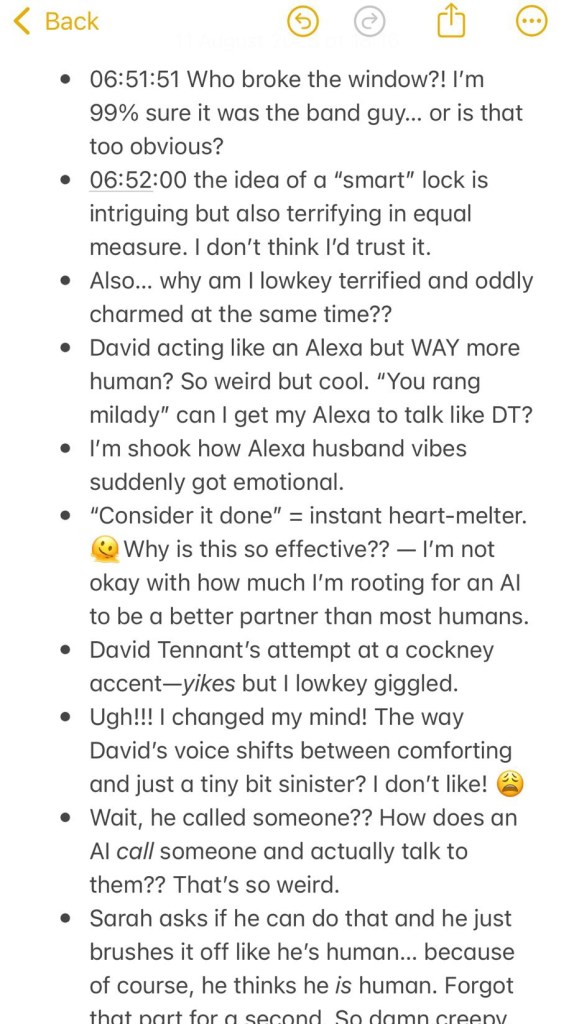
Annotating an audiobook is a unique experience since you can’t write directly in the margins, but I’ve found a great way to make it work.
While listening, I use Audible’s bookmark feature to mark key moments or passages that stand out to me. Whenever I hear something worth noting, I pause and add a bookmark, so I can easily return to that spot later.
Alongside this, I keep a notebook or digital note app handy to jot down quotes, thoughts, or questions inspired by the narration. This combination of bookmarking and note-taking turns listening into an active process, allowing me to engage deeply with the story and reflect on important details long after I finish the audiobook.
When I went back to find the notes I realise that half way through, I’d started calling him David, rather than Nick! Bit confusing as there IS a character called David within the narrative. But I know I meant Nick here, because the section I screenshot, only Nick and Sarah are on the page (in the ear? I’m confusing myself even more now)
Final Verdict:
Criticisms and Lingering Thoughts
While “HIM” is a captivating listen, there were a few aspects that didn’t fully resonate with me. Some of the plot twists felt a bit contrived, and the ending while satisfying in its own way, left a few lose ends. (How did it know about the baby name conversation?!)
Despite these minor criticisms, “HIM” is a thought provoking and emotionally resonant thriller that explores the complexities of grief, the allure of technology and the dark secrets that lurk beneath the surface of even the closest relationships. It’s a story that will stay with me long after the final words fade away.
Call to action: What do you think, have you listened to HIM? What were your thoughts? Feel free to leave your views below!
 The Book Goddess Reads
Leave a comment